

The Risk Isn't Where Your Club's Data Lives. It's How Old It Is.
Justin Roberts
September 16, 2026
Mobile Digital Licences strengthen firearms safety by improving verification and compliance while protecting the future of shooting sports.

Firearms licensing in Australia is built on a simple and widely supported principle:
firearms must only be accessible to people who are authorised, responsible, and compliant.
Most shooters understand this. Most clubs support it. And most people involved in the sport take safety seriously.
Where the conversation is starting to shift is how that authorisation is managed, checked, and supported in practice.
Across many industries, identity and licensing are moving away from physical cards and paper-based systems toward secure digital credentials. One of the clearest examples of this shift is the Mobile Digital Licence, often referred to as an mDL.
This article explains what an mDL is, why it matters, and why firearms licensing is a strong candidate for this approach, especially when combined with modern club systems and better data visibility.
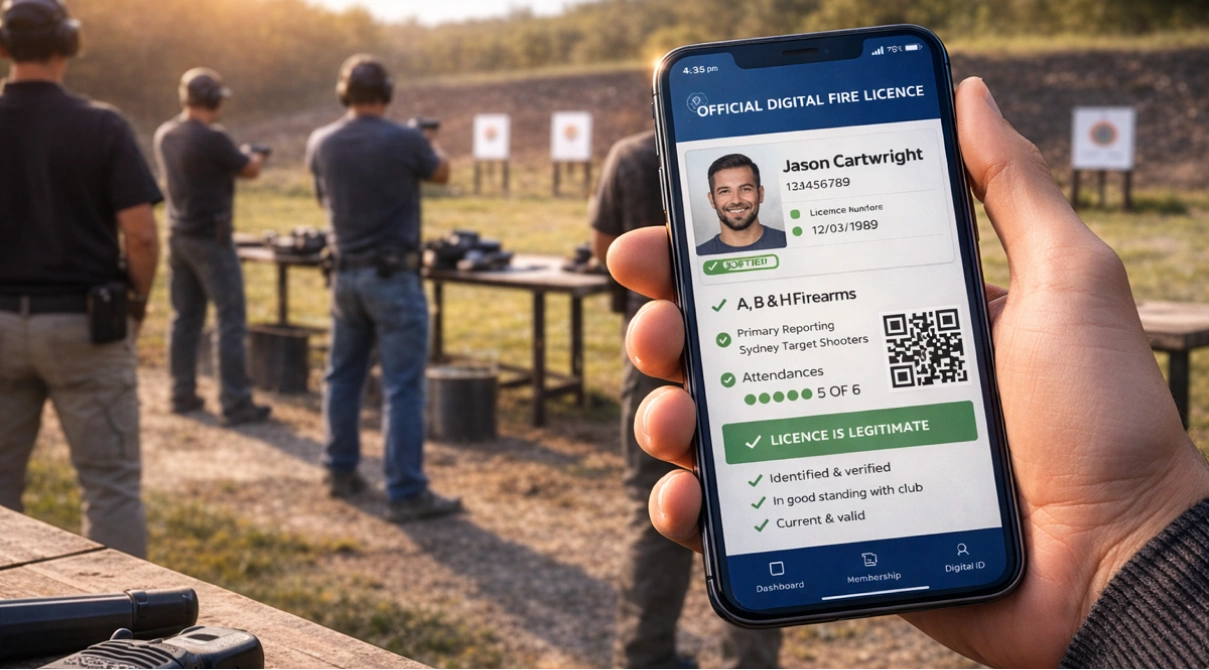
A Mobile Digital Licence (mDL) is a secure digital version of a licence that lives on your phone, typically in an official app or digital wallet.
It is important to be clear about what an mDL is not.
It is not:
An mDL is designed to do one thing very well:
prove that a licence is valid, genuine, and current at the moment it is checked.
In everyday terms, an mDL allows someone to confirm:
without relying solely on a physical card that may be out of date.
Australia is already moving in this direction with digital driver licences. Firearms licensing is a logical next area to consider the same principles.
In New South Wales, firearms licences are issued and managed by the NSW Police Force.
A firearms licence defines:
For most shooters, this information is represented by a physical licence card, supported by online services for applications and status checks.
This system has worked for many years, but it increasingly relies on:
As participation grows and expectations around safety and accountability increase, these limitations become more visible.
This is a crucial point that often gets lost in public discussion.
The firearms community has consistently demonstrated that:
The challenge has never been behaviour.
It is visibility.
When systems are outdated, manual, or disconnected, it becomes harder to clearly see:
This lack of visibility is not a failure of people.
It is a limitation of the tools they are expected to use.
Better systems do not exist to “watch” shooters.
They exist to support responsible participation, protect clubs and volunteers, and safeguard the long-term future of the sport.
This is where modern approaches such as Mobile Digital Licences (mDLs) become relevant, not as a control mechanism, but as a way to improve clarity, accuracy, and trust across the entire system.
Firearms licensing has characteristics that make it particularly suitable for a mobile digital approach.
In many situations, the key question is simple:
Is this person authorised to participate right now?
An mDL-style licence can reflect:
in real time, rather than relying on a card that may no longer tell the full story.
Most firearms use takes place at:
These environments already involve:
That makes them ideal places to introduce better, more reliable licence verification without increasing risk.
One of the strongest concerns raised by shooters is the fear of “Big Brother” monitoring.
That concern is understandable, but it misunderstands what modern digital licensing is designed to do.
An mDL does not exist to monitor behaviour.
It exists to confirm eligibility.
In fact, done properly, digital licences can:
Good systems are quieter, more accurate, and less invasive than manual ones.
Firearms sports rely on public confidence and strong governance.
When incidents occur, scrutiny often focuses on questions like:
Strong data and clear records help the sport demonstrate that:
This is not about tightening rules for responsible shooters.
It is about protecting the sport from blunt, reactive regulation caused by system failures.
Clubs sit at the point where firearms licensing becomes real.
They are responsible for:
Platforms like SquadSpot exist to support clubs with:
When combined with modern digital licence concepts, this creates:
Importantly, this improves compliance without changing the culture of the sport.
The move toward Mobile Digital Licences is not about control or surveillance.
It is about:
Better systems help ensure that:
people who should not have access, do not — and those who do are supported, trusted, and protected.
That benefits everyone.
Mobile Digital Licences represent a broader shift in how licensing and identity are managed in modern society.
For firearms licensing, the benefits are clear:
This is not about changing the values of the sport.
It is about giving those values better tools.
When implemented thoughtfully, mDLs are not a threat to firearms sport.
They are a way to secure its future.

