
The Risk Isn't Where Your Club's Data Lives. It's How Old It Is.
Justin Roberts
September 16, 2026
The nine features that actually determine whether your Australian club will still be using its membership management software in two years.


Every "best club membership software" listicle on the internet was written by the same person. You can tell because they all list the same 30 features in the same order, give every platform 4.7 stars, and conclude with "the right choice depends on your needs" — which is the SaaS-content equivalent of "it's a great walking-around city" when you ask someone what to do in Adelaide.
This is a different kind of guide. These are the nine features that actually determine whether your Australian club will still be using the membership management software in two years, or whether you'll be in a committee meeting at 9pm trying to explain to a frustrated treasurer why you're migrating again.
Print it. Take it to the AGM. Use it to ask hard questions of every vendor on your shortlist before they wear you down with a 47-slide deck.
Score each feature 1-5 for every club membership platform you're evaluating, then weight by how much each feature matters to your club. A small fishing club that runs one comp a year doesn't need the same depth as a multi-discipline shooting club submitting participation reports to the firearms registry.
Be honest about what you actually need. A surprising number of clubs buy enterprise-grade membership software because someone on the committee saw a YouTube ad for it, then proceed to use 11% of it. The features below are the ones that earn their keep.
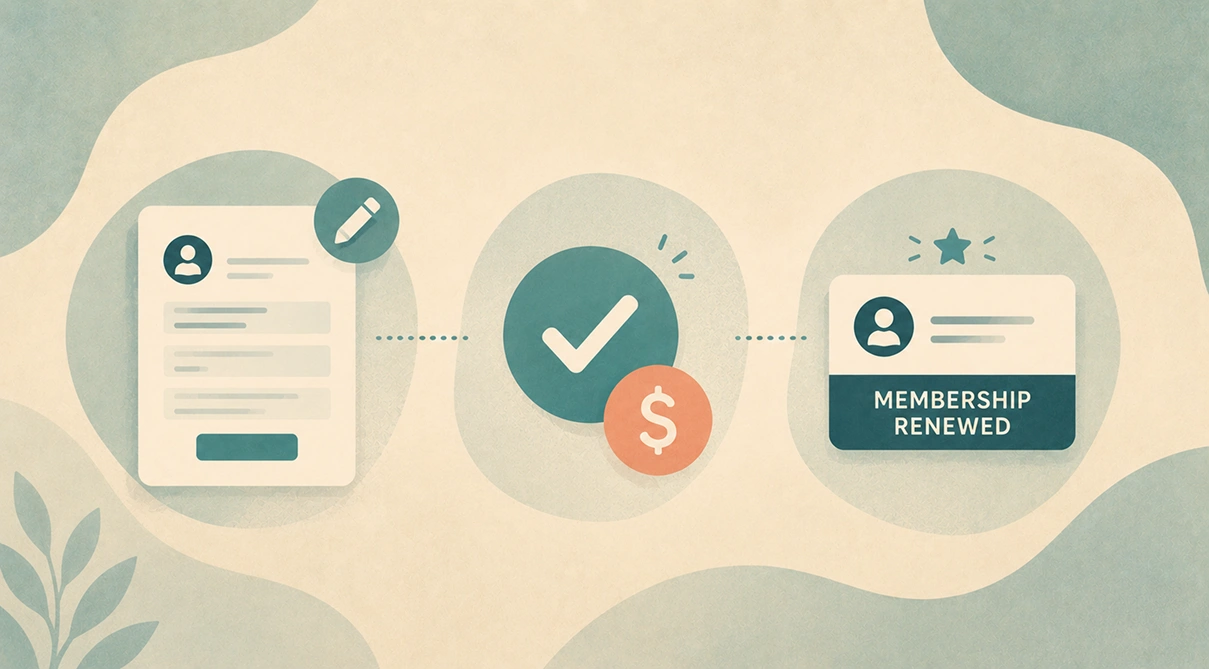
The single most-used feature in any club membership software is automated renewals. It's also where most platforms quietly fail. They automate the email but still require the secretary to manually click through a list every Sunday night, marking people as paid, lapsed, or in grace period like they're sorting Christmas cards.
That's not automation. That's a notification system with extra steps.
What to ask the vendor:
Red flag: the demo shows a "renewals" tab where the salesperson clicks through five members one at a time, smiling. That smile is doing a lot of work.
Plenty of global platforms support online payments. Fewer of them properly handle the Australian payment methods clubs actually use — BPAY, PayID, direct debit, and split payments are bread and butter for Australian clubs but get treated as exotic edge cases by international vendors built for the American chamber-of-commerce market.
What to ask the vendor:
Red flag: the platform charges its own transaction fee on top of what Stripe or your gateway already takes. You're paying twice and only one of those companies built the rails.
For Australian shooting clubs, participation reporting isn't a nice-to-have — it's a regulatory requirement. The NSW Firearms Registry, Victoria Police, and the other state jurisdictions all want evidence of genuine reason for licence renewal. "I think I came in May, maybe?" is not acceptable evidence.
But even for non-shooting clubs, attendance tracking matters. It tells you who's about to lapse, proves you delivered services to your funders, and produces the data that lets the committee make decisions without resorting to vibes.
What to ask the vendor:
Red flag: the "attendance" feature is a spreadsheet-like interface with a tickbox column and no way to capture attendance at the activity itself. Congratulations, you bought a digital paper sign-in sheet.
The fastest way to lose a new member is a clunky joining process. Paper forms photographed crookedly and emailed back, requiring the secretary to retype them into a spreadsheet at 10pm on a Tuesday, is still the standard process at hundreds of Australian clubs. It shouldn't be.
What to ask the vendor:
Red flag: the "online application" feature turns out to be a contact form. Different thing.
If you're exporting member lists to Mailchimp every renewal cycle, you've already lost. The data goes stale immediately, you can't segment by anything useful (attendance, lapsed status, discipline), and you're paying two tools for what should be one job.
What to ask the vendor:
Red flag: vendors who suggest you "integrate with your existing email tool". This is code for our built-in email is bad and we know it.
Your treasurer needs to see payments. Your secretary needs to see contact details. Your RSO needs full attendance visibility but doesn't need to know who's behind on fees. Your range captain shouldn't have to text the secretary every time they need a member list at 7am on a Sunday.
What to ask the vendor:
Red flag: the pricing page charges per user. A club with 8 committee members shouldn't have to buy 8 licences on top of the membership management software subscription. That's just inflating the bill.
Almost every membership platform claims "powerful reporting." Almost none of them produce a report that a volunteer treasurer can put in front of an AGM without an interpreter and a glass of wine.
What to ask the vendor:
Red flag: the "reports" section is mostly empty templates the vendor expects you to construct yourself. You bought membership software, not a Saturday afternoon SQL homework assignment.
This sounds obvious, but it matters more than vendors admit. A global platform with support based in North America means your treasurer's urgent renewal question on Saturday morning gets answered Sunday night their time — Monday morning yours, after the renewal window has closed and the member has emailed you three times in increasingly aggressive tones.
What to ask the vendor:
Red flag: vendors who advertise "24/7 support" but the response time data shows 18-48 hour averages. That's not 24/7 support. That's 24/7 acknowledgement.
This is the feature most committees never check until they want to leave. By then it's too late, and you're either paying ransom or losing five years of member history.
What to ask the vendor:
Red flag: any vagueness on this question. A reputable Australian membership management software vendor will give you a one-sentence answer: yes, anytime, CSV, no fee. Anything else is a warning.
These aren't features. They're the stuff that determines whether you'll still be happy with the platform after the honeymoon period.
Setup cost vs. monthly cost. A platform with a low monthly fee but a $2,000 setup cost is often more expensive over five years than one with a higher monthly fee and zero setup. Do the maths. The vendors won't.
Feature depth vs. usability. The platform with the most features is rarely the platform your committee will actually use. Watch the demo and ask: would the 72-year-old life member who's been treasurer for 15 years be able to use this without ringing his grandson?
Customisation vs. configuration. "Highly customisable" usually means "requires consulting hours to set up". "Highly configurable" usually means "we made the common stuff easy". You want the second one.
Reputation vs. reality. Big-name international vendors with global reach often have less Australian-specific functionality than smaller AU-built platforms. The biggest brand isn't always the best fit. Ask whoever recommended them the last time they actually used it.
Full disclosure: this checklist was written by Squadspot. We built the platform around exactly these features because we kept watching Australian clubs get burned by international membership management software that didn't understand their world. The treasurer in Bowral does not care about the chamber-of-commerce feature roadmap in Ohio.
Squadspot is club membership software built for Australian clubs specifically — shooting, sporting, and structured clubs with compliance obligations, recurring memberships, and the operational reality of running a club on volunteer hours. Every feature in this checklist is core to the platform, not an upsell.
If you'd like to see how Squadspot handles each of these nine areas in practice, book a free demo and we'll walk through them with your specific club in mind. No 47-slide deck. Promise.
See Squadspot's full club membership software →

