How to Run a Club AGM in Australia: Deadlines, Notice, Agenda and Lodgement
Justin Roberts
October 20, 2026
Spreadsheets work until they don't. Here's how to tell when your club has outgrown the DIY approach and needs membership management software.

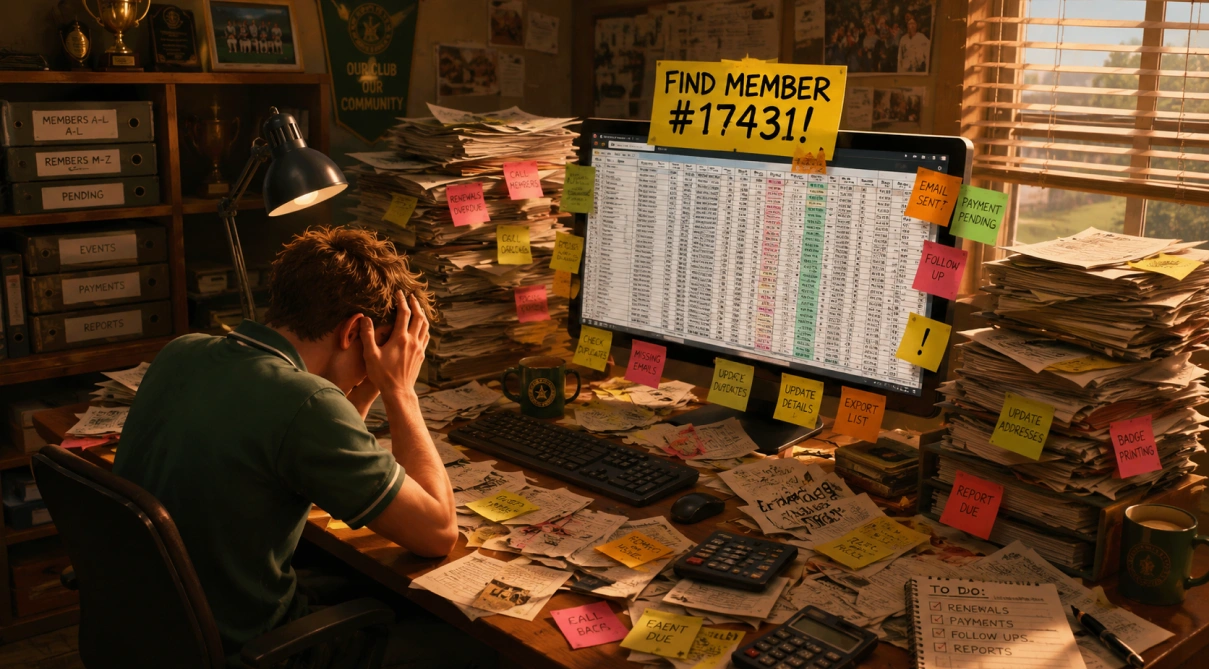
Almost every Australian club starts the same way. Someone sets up a spreadsheet. Maybe two. A list of members, a tab for payments, perhaps a third for attendance if the club is particularly organised. It works. For a while, it works really well. You can see your members at a glance, you can sort by category, you can email everyone at once by copying column C into Outlook.
Then one day, it doesn't work. Not catastrophically — spreadsheets rarely fail dramatically. It just gets harder. The file takes longer to open. Someone overwrites the wrong cell. The committee member who built the formulas moves on, and nobody else quite understands how the renewal reminders are calculated. The club is busy, and the spreadsheet is where all the knowledge lives, and everyone just hopes nothing breaks.
This is the point where most clubs start looking for membership management software. Not because spreadsheets are bad — they aren't — but because the club has outgrown them. Knowing when you've reached that point, and what to do about it, is the subject of this article.
Before getting into when to leave them behind, it's worth being fair to spreadsheets. They get a lot of stick in SaaS marketing material, and most of it isn't entirely honest. Spreadsheets are free, familiar, and extraordinarily flexible. They don't require training. They work offline. They can be emailed, backed up, printed, annotated, duplicated, and reshaped into whatever your club needs them to do that week. For a club of 20 members running one event a year, there is no practical reason to use anything else.
The problem isn't that spreadsheets are the wrong tool for small clubs. The problem is that clubs don't stay small, and spreadsheets don't scale gracefully. They degrade. Slowly, then suddenly.
There are a few patterns that show up consistently when clubs move from spreadsheets to membership management software. None of them are dramatic on their own. Together, they're a clear signal that the DIY approach has reached its limits.
A single source of truth becomes multiple sources of confusion. The secretary's membership list has one version of a member's contact details. The treasurer's payment tracker has another. The events coordinator's attendance log has a third. Nobody is wrong, exactly — the systems just drifted. When somebody asks "is John still a current member?", the answer depends on which file you open.
This is the most common symptom of a club that has outgrown spreadsheets, and it's almost always the most costly one. Because when the data disagrees, compliance records get fuzzy, renewal reminders go to the wrong people, and members start losing trust in the club's ability to manage their information accurately.
If someone on the committee is spending four hours a week chasing renewals — calculating who's due, drafting reminder emails, reconciling payments against the bank statement, updating expiry dates — the club is paying a real cost. That cost might not show up on a budget line, but it shows up in volunteer burnout, in meetings that run late, in jobs that don't get done because the membership admin swallowed the week.
Membership management software automates most of this. Not all of it — somebody still needs to review exceptions — but the routine work becomes routine, which is the entire point.
This is the one that kills clubs. When the membership secretary steps down, everything they knew leaves with them. Where's the master list? In a OneDrive folder, mostly, except the current version is actually on Sue's personal laptop. What's the formula that calculates renewal dates? It was in the old spreadsheet, but nobody can find it. How do we send out the annual renewal email? Janet used to do it, and she's moved interstate.
Clubs that rely on spreadsheets rely on the people who built them. When those people leave, the club effectively restarts from scratch. A platform removes this dependency — the processes live in the system, not in somebody's head.
For clubs with regulatory obligations, this is where the spreadsheet model breaks hardest. If your club needs to produce records of attendance linked to specific activities, evidence of current member licences, logs of firearms inventory, or records of who used which club-owned equipment, a spreadsheet can technically hold that data. But it can't link it, time-stamp it reliably, prevent backdating, or produce audit-ready reports on demand.
A shooting club trying to demonstrate that members met their mandatory participation requirements under state firearms legislation is in a different conversation than a photography club tracking who came to the monthly meet-up. The stakes of getting it wrong are much higher, and the tolerance for "I'll have to go back and reconstruct that" is much lower. This is the kind of problem membership management software was built to solve.
Members today expect the same digital experience from their club that they get from their bank, their gym, and their kid's school. They want to update their own details, pay renewals online, download their membership card to their phone, and see their attendance history without emailing the secretary. A spreadsheet can't offer any of that. Every one of those requests becomes a manual job for a volunteer, which compounds the renewal-time problem.
The question isn't really "spreadsheets or software?" — it's "what does the software actually do that the spreadsheet doesn't?" Because if the answer is "it's just a fancier spreadsheet," there's no point switching. The real change is structural.
A proper membership platform holds member data in a single database. When a member updates their address, it updates everywhere. When a payment is processed, the membership status changes automatically. When attendance is logged, it links to the member record and the specific activity. There's no possibility of three versions of the truth drifting apart, because there is only ever one version.
This sounds mundane. It's probably the single biggest operational change a club experiences when moving off spreadsheets.
Renewal reminders go out automatically, thirty days before expiry, fourteen days before, seven days before — whatever cadence the club configures. Payment confirmations are sent the moment the bank settles. New members receive welcome emails the second their application is approved. The committee stops being the email engine of the club. Nobody forgets. Nobody sends the same reminder three times because they lost track.
In a spreadsheet model, processes exist as informal agreements. "When someone applies, the secretary checks their details, forwards the application to the committee, waits for approval, then updates the database and sends the welcome email." Most of that is in someone's head. It works if everyone remembers it.
Membership management software converts these processes into configurable workflows. The application form collects the right information. Committee members review and approve inside the system. Status changes automatically on approval. Communications fire when the workflow reaches the right step. The process is documented because the process is the software.
Spreadsheets can produce reports, but only the reports their creator thought to build. Membership software lets you ask questions of the data that weren't anticipated. How many members have renewed late in the past three seasons? Which categories are growing and which are shrinking? What's the attendance distribution across our disciplines? When the committee changes strategy, the data can support the decision immediately.
Membership doesn't exist in isolation. Payments integrate with a payment processor. Emails go through a real email engine that doesn't end up in spam folders. Digital membership cards live on members' phones. Events have registration. Attendance links to activities. The whole operation becomes a connected system rather than a handful of disconnected tools held together by copying and pasting.
Consider a shooting club with 300 members. In a spreadsheet world, the secretary maintains the member list, the range officer keeps attendance records on paper sign-in sheets, the treasurer tracks payments in a separate workbook, and somebody — maybe the secretary, maybe the president, depending on how the work was allocated — produces the annual participation report for the Firearms Registry by cross-referencing all three.
The process takes days. It depends entirely on the attendance sheets being legible and the dates being correct. If a member's participation record is queried, the club reconstructs it manually. When the volunteer who runs this work steps down, the next person spends a season learning how it fits together.
In a platform world, the same club's check-in happens digitally. Attendance is logged against the member record with a time-stamp and the specific discipline. Payments link to membership status automatically. The annual participation report is a button. When the compliance question comes from the registry, the answer is already in the system. The volunteer who administers the club spends their time on members, not on reconstruction.
This pattern repeats across compliance-sensitive club types — car clubs managing historic registration schemes, yacht clubs tracking safety certifications, surf clubs maintaining patrol records. The underlying shift is the same: from manual reconciliation to structured data.
One of the reasons clubs delay the move is they imagine the transition will be disruptive. In practice, it's usually less work than the decision to start. A reasonable migration from spreadsheets to a dedicated platform involves exporting the current data, mapping it to the new structure, importing it, and running the two systems in parallel for a renewal cycle or two so the club can verify the new system is working before the old one is retired.
The biggest cost is time, not money — and the bulk of the time is spent clarifying the club's processes, which often weren't written down anywhere. Moving to a platform forces a club to articulate how things actually work, which is valuable in itself.
Most clubs that make this move are surprised by how quickly the new system starts paying back. The reduction in admin time shows up within weeks. The reduction in errors shows up within a renewal cycle. The reduction in committee handover pain shows up the first time someone steps down without leaving the club mid-crisis.
Here's a straightforward test. Ask the three people most involved in running the club to each describe, separately, how the renewal process works. If their answers differ in any meaningful way, the club has outgrown spreadsheets. Undocumented processes held in three different heads are not a system — they're a liability waiting to be called in.
Same test with any of these questions: How do new members join? How is attendance recorded? How is compliance reporting produced? How are payments reconciled? If the answers disagree, or if the answer depends on which volunteer is asked, the club is running on informal knowledge. A platform replaces that informal knowledge with explicit structure — and a club that runs on structure is a club that can grow, handle committee change, and survive the day the founding volunteers hand over the keys.
It would be dishonest to pretend there's no downside. Membership management software costs money that spreadsheets don't. It requires some initial setup time. There's a learning curve for volunteers who've run the old system for years. And the wrong platform — a generic one designed for yoga studios or professional associations — can end up being worse than the spreadsheet it replaced.
The pragmatic answer is that a good membership management platform, chosen to match the club's actual operations, pays for itself quickly in volunteer time and operational resilience. The wrong platform doesn't. So the decision isn't just "should we get off spreadsheets?" — it's "what do we replace them with, and does it actually understand how our club works?"
This is the deeper point. The move off spreadsheets isn't primarily a technology decision. It's an operational one. The club is deciding to make its processes explicit, connected, and durable. The software is the tool for doing that. Choosing a platform that treats your club as a first-class citizen — with the specific workflows you actually run, not a generic member list — is what makes the transition worth making.
If this article has described your club — multiple spreadsheets drifting out of sync, renewals eating volunteer time, committee handovers that feel like starting over, compliance that lives in one person's head — the question isn't whether to move to membership management software. It's what to move to, and when.
SquadSpot is built for exactly this transition. Our membership management software handles the real workflows Australian clubs run on: applications, renewals, payments, attendance, compliance reporting, communications, and digital membership issuance — all tied together in a single platform built specifically for the kinds of clubs that spreadsheets eventually fail. If you'd like to see what that looks like for your club, book a free demo and we'll walk you through how it works in practice.