

The Risk Isn't Where Your Club's Data Lives. It's How Old It Is.
Justin Roberts
September 16, 2026
Licence applications are climbing and the data tells a different story to the headline panic. A look at what's actually happening.

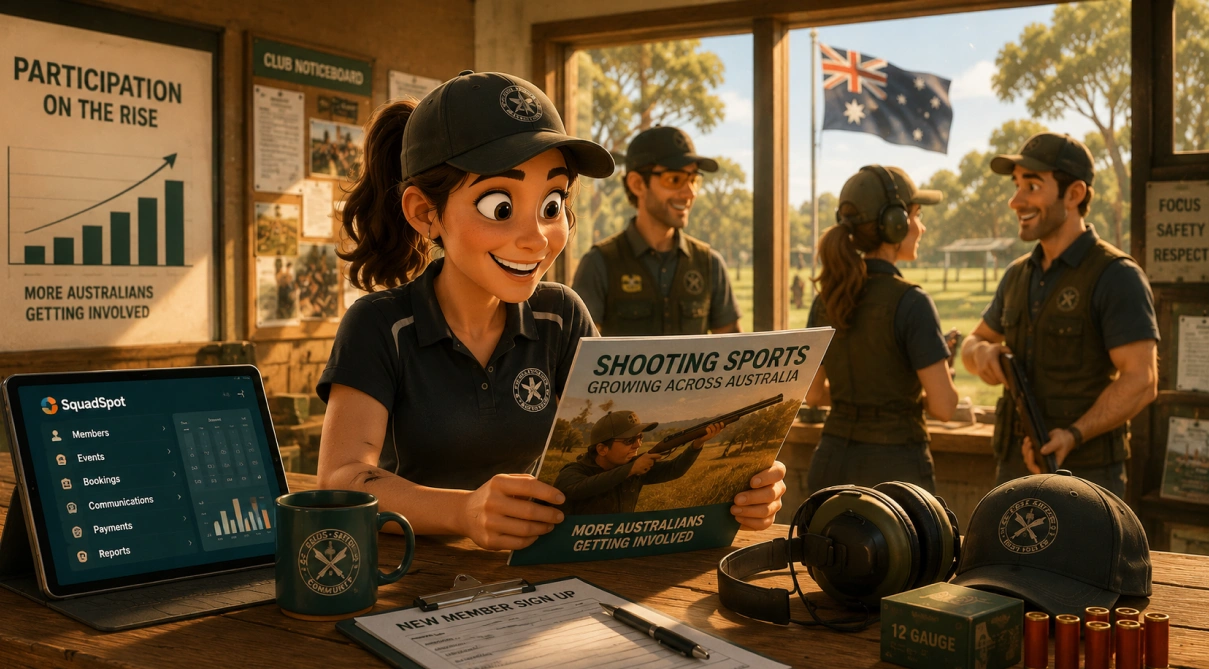
There's a story doing the rounds at the moment that goes something like this: firearm licence applications are climbing in Australia, therefore Australia is in trouble. Cue the headlines, the maps with red dots over suburbs, the breathless "did you know there are this many guns in your postcode?" exposés.
Here's the thing the panic-cycle keeps forgetting: licensed sport shooters aren't the problem, and the data doesn't say they are.
Licensed sport shooters aren't the problem, and the data doesn't say they are.
ACT Police told a Legislative Assembly committee in April that monthly firearm licence applications jumped 57% after the Bondi attack — and importantly, Superintendent Richard Breiner noted the increase was largely from partners and spouses of existing licence holders, not new firearms entering circulation. People are getting licensed for guns that are already lawfully owned by their family.
In NSW, registered firearm owners passed 248,000 by late 2022 and have kept climbing since. The vast majority of NSW licences sit in two categories: recreational hunting and vermin control (around 62%) and sport target shooting (around 20%). Primary production accounts for most of the rest. These are farmers, hunters and sport shooters — not a brewing militia.
For context, the Sporting Shooters' Association of Australia alone has over 215,000 members. That's bigger than the membership of the AFL Players Association, the Australian Cricketers' Association, and most political parties combined. We're not a fringe — we're a sport.
Sporting Shooters' Association of Australia alone has over 215,000 members. We're not a fringe — we're a sport.
There's a website that lets you punch in a postcode and see how many registered firearms live there. Predictably, the suburbs with the most guns tend to be… the suburbs with the most people. Camden, Bligh Park, the Illawarra. You'll be shocked to learn that areas with more residents also contain more golf clubs, more lawnmowers, and more KitchenAids.
The argument essentially boils down to: "There are a lot of legally registered, lawfully stored firearms owned by background-checked sport shooters and farmers, and that makes us nervous." Okay. But "makes us nervous" isn't a public safety analysis. It's a vibe.
Imagine applying the same logic to anything else. "There are 1.6 million registered golfers in Australia and over 1,500 golf courses. Some individuals own more than 14 clubs. We've identified the postcodes where these private arsenals of putters are accumulating." It sounds absurd because it is.
The difference is that golf clubs aren't politically useful as a moral panic. Firearms are.
After the Bondi attack last December, the Royal Commission on Antisemitism and Social Cohesion released its interim report. Buried under the headlines was a finding worth quoting: no agency suggested that the current legislative framework prevented intelligence or law enforcement agencies from taking action that may have prevented the Bondi attack.
Read that twice. The laws weren't the failure point. The Commission also did not recommend capping the number of firearms an individual can hold — the policy that's been front and centre in the post-Bondi debate.
What the Commission did flag was an intelligence-sharing problem and a "cleanskin" risk — extremist-linked individuals using associates without records to obtain licences. That is a real concern, and it's one the sport shooting community shares. But the answer to that problem isn't "fewer target shooters." It's better information sharing between agencies, which is exactly what the National Firearms Register is meant to do — and which the Commission criticised governments for delivering at an "unduly leisurely" pace, with full integration not expected until 2028.
So: the licences going up are largely partners getting properly licensed for guns already in the home. The Royal Commission found existing laws weren't what failed. And the genuine reform priority is intelligence and registry integration, not capping how many rifles a club shooter can own.
If you went looking for a story that says "the rising number of sport shooting licences is the danger," the data isn't there. It's just not.
Run the thought experiment. Magic wand, every legally registered firearm in Australia disappears overnight. Are we safer?
The Bondi gunmen had legally acquired firearms — that's the case for tighter screening of licence applicants, and it's a fair argument. But Australia's other recent mass-casualty attacks weren't carried out with legal firearms. The Bondi Junction stabbings. The Wakeley church attack. Both terrible, both happened in a country with some of the strictest gun laws in the developed world, neither involving a licensed sport shooter's rifle.
People intent on harming others find a way. The evidence for this is, regrettably, overwhelming. Disarming the 250,000-odd sport shooters and farmers in NSW doesn't address radicalisation, mental health crises, domestic violence, or intelligence failures. It just makes a sport harder to participate in for the people who already follow every rule.
Sport shooting has been an Olympic event since the first modern Games in 1896. Australia has won medals in it. There are kids and grandparents and tradies and accountants at clubs every weekend, hitting steel plates, shooting clays, running stages. Most of them will never own more than two or three firearms in their life. Almost none of them will ever fire one outside a range or a property.
To get a licence in NSW you need a genuine reason, a safety course, police background checks, secure storage that's inspected, and a 28-day cooling-off period. Permits to acquire each individual firearm require their own justification. Compare that to the requirements for owning a car, which kills more Australians every year than firearms have in any single year since 1996.
The data points at the first answer. The headlines keep choosing the second.
More Australians getting properly licensed, properly trained, and properly engaged with a regulated sport is a positive trend. It means more people inside the system, not outside it. It means more clubs, more coaches, more kids learning safety, more competitive shooters representing Australia internationally.
The story isn't "guns are flooding the suburbs." The story is "an Olympic sport with a 130-year history is growing, and the people joining it are following every law on the books."
That's worth defending. And it's worth being honest about: every shooter at every club wants the same thing the wider public wants — bad actors kept away from firearms. The disagreement is just about whether the way to do that is to focus on bad actors, or to make life harder for the 99.9% of licensed shooters who have never been one.
The data points at the first answer. The headlines keep choosing the second.

