

The Risk Isn't Where Your Club's Data Lives. It's How Old It Is.
Justin Roberts
September 16, 2026
A practical guide to checking firearm licences in NSW — the official tool, its limitations, and how clubs can move toward real-time compliance.

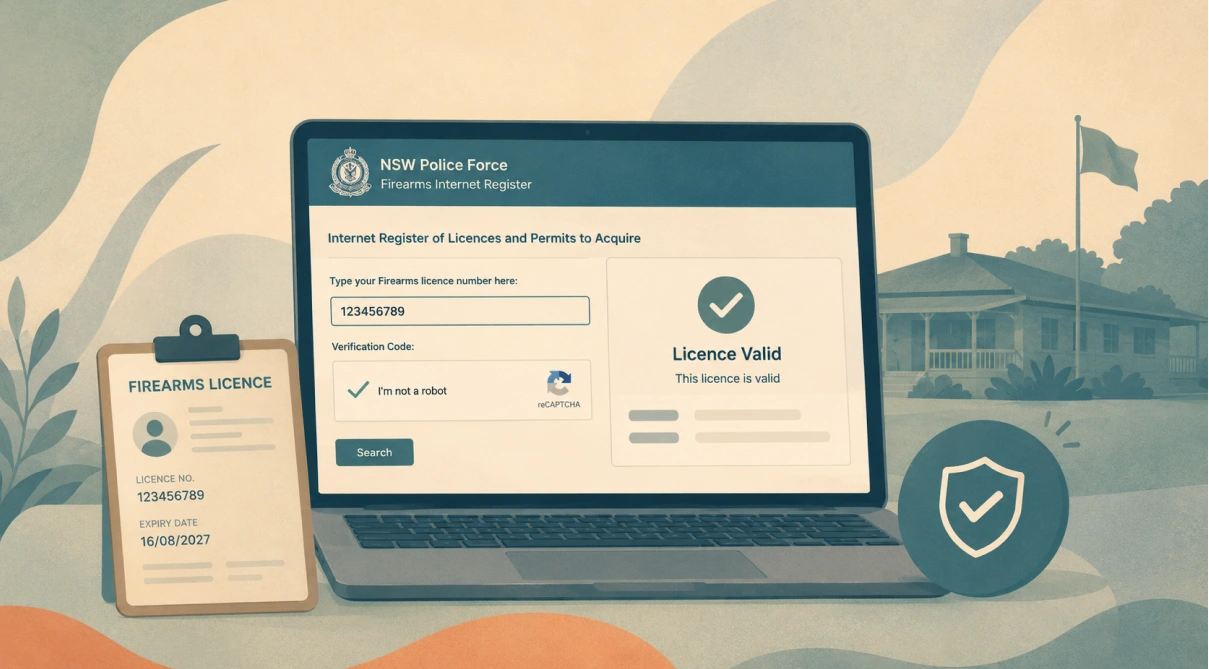
For shooting clubs, ranges, and event organisers, verifying a member's firearm licence is not optional. It is a core part of compliance, safety, and operational responsibility.
Whether it's a visitor attending for the first time, a member participating in pistol shooting, a club recording attendance for compliance reporting, or a Permit to Acquire (PTA) being used for a specific firearm — clubs are expected to ensure that the individual is properly licensed and authorised for the activity they are undertaking.
The challenge is that the process is still largely manual, inconsistent, and disconnected from modern club systems.
NSW Firearms Licence Check Tool
Verify licence status, expiry, and PTAs
Enter a licence number and verification code to confirm whether a NSW firearms licence is currently valid. Free to use — no login required. Available to club officials, dealers, and the general public.
The NSW Police Firearms Registry provides an official licence verification tool — commonly referred to as the NSW Firearms Licence Check Tool. It allows users to enter a firearms licence number, confirm whether the licence is valid, check expiry status, and verify basic licence details.
You can access the tool directly here: https://apps.police.nsw.gov.au/FPR/licenceCheck/search.jsp
It’s used by firearms dealers, club officials, range officers, and individuals verifying licence status — and there’s ongoing discussion in shooting community forums about its strengths and limitations.
The official tool serves an important purpose. It provides a centralised, government-backed source of truth, allows quick validation of licence status, reduces reliance on paper-based licence checks, and supports basic compliance requirements. For one-off checks, it’s effective.
Where things break down is at the club level.
Every check requires opening the site, entering licence details, and verifying results. This doesn’t scale when 50+ members check in on a weekend, when visitors arrive in groups, or when events and competitions are running.
The tool exists in isolation. It isn’t connected to club membership systems, can’t be embedded into check-in workflows, and there’s no API or automation layer available. This means clubs are double-handling data, switching between systems, and relying on human memory and process.
While the tool confirms validity, it doesn’t clearly map Genuine Reasons to club approvals, integrate with attendance records, or track historical verification logs. A licence may be valid, but not valid for the discipline being shot — and clubs still need to interpret and validate this manually.
Clubs often need to demonstrate when a licence was checked, who checked it, and what the result was. The current system doesn’t support this in a structured way.
There’s another layer to this that is often overlooked. Even when clubs are diligently using the NSW Firearms Licence Check Tool, the process is still manual, point-in-time, and dependent on a club official.
Licensing conditions can change — suspensions, expiry updates, changes to Genuine Reasons, PTA status updates. These changes occur within government systems, but clubs are only aware of them when someone manually performs a check, or when the member self-discloses. This creates a gap where a licence may no longer be valid or appropriate, but the club continues operating under outdated information.
In many clubs today, the process looks like this: a member presents their licence, a club official visually checks it or uses the tool, and a manual sign-off or assumption is made.
This introduces risk — incorrect data entry, misreading licence categories, skipping checks during busy periods, and inconsistent processes between volunteers. Even with the best intentions, the system relies heavily on human consistency under time pressure.
The current model answers one question: “Was this licence valid at the moment it was checked?”
What it doesn’t answer is whether it’s still valid later that day, whether anything has changed since the last visit, or whether the member is still compliant for this specific activity. Without integration, there’s no automatic re-validation, no alerts for status changes, and no linkage between licence status and actual participation.
Because of these gaps, clubs are often catching issues after the fact, relying on audits instead of prevention, and manually reconstructing records if something goes wrong. This increases administrative burden, compliance risk, and exposure for committee members and range officers.
Permits to Acquire (PTAs) add another layer of complexity. Clubs and officials may need to verify that a PTA is valid, ensure the firearm being used aligns with the licence category, and confirm compliance for participation or training. Again, this is manual, disconnected, and not linked to attendance or participation data.
NSW isn’t the only state with a licence verification system — but the approach varies significantly across jurisdictions, and the user experience for club officials is far from consistent.
Queensland offers an Online Licence Verification Tool through the Queensland Police Service Weapons Licensing Group. It works similarly to the NSW tool — users enter the licence number and expiry date to confirm status. Under Queensland’s Community Safety Act, sellers of small arms ammunition are now required to use this system to verify a buyer’s weapons licence at the point of sale.
Victoria has taken a different approach. Rather than a public lookup tool, Victoria Police have rolled out a digital firearms licence through the Service Victoria app. Licences are verified via QR code — a unique code regenerates every two minutes and can be scanned by dealers, club officials, or range officers. Information is pulled directly from the Victoria Police Licensing and Regulation Division in real time.
South Australia uses a similar digital-licence model through the mySA GOV app. The app includes a “shake to verify” feature that overlays the current date and time to confirm authenticity, and licence holders can display their digital licence to officials. A customer portal is also being developed as part of the South Australian Firearms Register (SAFR) project.
WA operates a Licensing and Registry Public Portal that allows licence holders to check the status of their application or the expiry of their current licence. This is more oriented toward self-service than third-party verification — though it forms part of WA’s broader firearms licensing reform, which we’ve covered in detail in our article on adapting to Western Australia’s Firearms Act 2024.
Smaller jurisdictions generally rely on direct contact with their firearms registries rather than public-facing lookup tools. Verification is typically done by phone or email through the relevant state police firearms unit.
Longer term, the National Firearms Register (NFR) — a four-year initiative that commenced in July 2024 and is expected to be operational by mid-2028 — will bring greater consistency across jurisdictions. The NFR is being designed as an integrated system that connects and draws information from Commonwealth, state, and territory firearms registries into a single central register, delivering a lifecycle view of registered firearms in Australia.
Until that happens, clubs operating across state borders — or handling interstate visitors — need to work with a patchwork of verification methods that differ in both format and reliability.
This is the key issue. Licence checking today is a separate task, performed outside the system of record, and not linked to attendance, scoring, or compliance reporting. Which leads to missed checks, inconsistent processes, and increased risk for clubs.
For clubs to operate efficiently and remain compliant, licence checking needs to be embedded, automated, context-aware, and logged.
Embedded means built directly into member check-in, visitor registration, and event participation workflows — not a separate task sitting outside the system.
Automated means triggered at the point of attendance, rather than relying on manual steps that may or may not happen under time pressure.
Context-aware means validating not just the licence itself, but whether the member is approved for the specific activity they’re attending.
Logged means every check is recorded, time-stamped, and linked to attendance records — giving clubs the audit trail they need without any additional administrative work.
This is exactly where Squadspot is heading. Instead of treating licence verification as a separate process, Squadspot integrates it into the core club workflow.
During check-in, a member or visitor enters their details and licence validation can be triggered in real time. Within attendance records, licence status is linked to each attendance — ensuring compliance is tied to actual participation. For reporting, clubs can produce structured compliance reports that include validated attendance and participation data. And at scale, this works across the club level, the branch level, and provides state-level visibility.
The NSW Police tool solves the verification problem. What it doesn’t solve is the workflow problem. This creates a clear opportunity for clubs and associations to move from manual checks to integrated systems, from isolated validation to connected compliance data, and from reactive reporting to real-time visibility.
For associations like SSAA and others, this becomes even more powerful when applied across multiple branches.
If your club relies on manual licence checks today, it’s worth raising this with your state firearms registry. There is currently no integrated way for club systems to verify licence status in real time — and as more clubs move toward digital attendance and compliance systems, the need for secure, system-to-system validation is only growing.
Clubs and associations can play an important role by advocating for secure API access for licence verification, real-time validation during check-in, and better integration between licensing and club systems.
This does two things: it educates the market, and it creates bottom-up pressure — the kind of pressure that tends to move regulators faster than top-down mandates ever do.
You can verify a NSW firearms licence using the official NSW Police Firearms Registry tool at apps.police.nsw.gov.au/FPR/licenceCheck/search.jsp. Enter the licence number and the on-screen verification code to confirm whether the licence is currently valid. The tool is publicly accessible and free to use — no login or account is required.
The tool is available to anyone, including the general public, licensed firearms dealers, approved shooting clubs and club officials, licensed club armourers, licensed security firms, and government agencies. Dealers are legally required to verify a licence before facilitating a firearm transaction.
A status of “Valid” means the licence has been issued by the NSW Firearms Registry and is currently active. Other statuses include “New Application in Progress — Not authorised for Firearms” (application received but not yet approved), “Reapplication in Progress — Authority continues” (renewal being processed, existing authority remains), and “New Application referred to Service NSW for Issue” (approved but physical licence not yet produced). If a licence is invalid or does not exist, the tool displays “This licence is not valid.”
Yes. The same tool allows you to verify PTA status. A PTA will show as “Valid” if it has been issued, or “Application in progress” if it is still being processed by the Firearms Registry. PTAs that have been used, expired, or are no longer in a valid status will not be displayed.
No. The NSW Police tool carries a NOINDEX directive, meaning it does not appear in Google search results. This is why it can be difficult to find — searching for “check firearms licence NSW” will not return the official tool directly. You need to navigate to it via the NSW Police Firearms Registry website or use the direct link provided in this guide.
The tool is effective for one-off manual checks but has significant limitations at club scale. It is not integrated with any club management system, has no API for automation, does not link verification results to attendance records, and provides no audit trail of when checks were performed and by whom. For clubs running multiple sessions per week with 50 or more members, this creates operational friction and compliance risk that manual checking cannot easily resolve.
If a licence returns “This licence is not valid,” it may mean the licence has expired, been suspended or revoked, or was never issued. It can occasionally also indicate a temporary system outage — the tool has been known to return incorrect results during maintenance periods. If you believe a result is in error, contact the NSW Police Firearms Registry customer service line on 1300 362 562 (Monday to Friday, 9am–4pm).
Not yet. Victoria uses a digital licence via the Service Victoria app with a QR code that refreshes every two minutes. South Australia uses a similar digital model via the mySA GOV app. NSW currently issues physical photo licences through Service NSW and relies on the online register for third-party verification. The national Firearms Register (NFR), expected to be operational by mid-2028, may bring greater consistency across all jurisdictions.
The current licence check tool is useful, but it reflects an older model of compliance — one-off checks, manual processes, disconnected systems. Clubs are evolving. The next step isn’t just checking licences. It’s embedding compliance into everyday club operations.
If you’d like to see how Squadspot handles licence verification, attendance, and compliance reporting for Australian shooting clubs, book a free demo — we’re happy to walk you through the platform.

